DataFab Graph Operations
Version: 4.3
Last Updated: May 2026
Component Overview
The Graph Operations module provides comprehensive capabilities for entity analysis, pattern detection, and operational decision-making. It leverages the Knowledge Fabric’s graph-based entity resolution and the Studio’s workflow capabilities to deliver an integrated operational intelligence solution.
Core Capabilities:
| Capability |
Description |
Security Relevance |
| Knowledge Graph Integration |
Entity resolution and relationship mapping |
Data integrity, access control |
| Rule Engine |
Pattern scoring and operational decision rules |
Rule versioning, audit trail |
| Graph Workflows |
Multi-step operational process orchestration |
Process authorization, escalation |
| External Enrichment |
Data enrichment and third-party integration |
Source validation, provenance |
| Graph Screening |
Entity screening against external sources |
Match verification, false positive handling |
| Case Management |
Operational case tracking and documentation |
Evidence chain, retention |
Architecture Overview
┌─────────────────────────────────────────────────────────────────────────┐
│                    GRAPH OPERATIONS ARCHITECTURE                        │
├─────────────────────────────────────────────────────────────────────────┤
│                                                                         │
│  ┌────────────────────────────────────────────────────────────────────┐ │
│  │                    OPERATIONS INTERFACE                            │ │
│  │  ┌──────────────┐  ┌──────────────┐  ┌──────────────────────────┐  │ │
│  │  │  Case Queue  │  │  Dashboards  │  │  Reporting & Analytics   │  │ │
│  │  └──────────────┘  └──────────────┘  └──────────────────────────┘  │ │
│  └────────────────────────────────────────────────────────────────────┘ │
│                              │                                          │
│  ┌────────────────────────────────────────────────────────────────────┐ │
│  │                    OPERATIONS ENGINE                               │ │
│  │  ┌─────────────┐  ┌─────────────┐  ┌─────────────┐  ┌───────────┐  │ │
│  │  │  Rule       │  │  Graph      │  │  Screening  │  │   Case    │  │ │
│  │  │  Engine     │  │  Workflows  │  │  Service    │  │  Manager  │  │ │
│  │  └─────────────┘  └─────────────┘  └─────────────┘  └───────────┘  │ │
│  └────────────────────────────────────────────────────────────────────┘ │
│                              │                                          │
│  ┌────────────────────────────────────────────────────────────────────┐ │
│  │                    KNOWLEDGE FABRIC INTEGRATION                    │ │
│  │  ┌─────────────────┐  ┌─────────────────┐  ┌────────────────────┐  │ │
│  │  │ Knowledge Graph │  │ Entity          │  │ External Source    │  │ │
│  │  │ (Entities &     │  │ Resolution      │  │ Integration        │  │ │
│  │  │  Relationships) │  │                 │  │                    │  │ │
│  │  └─────────────────┘  └─────────────────┘  └────────────────────┘  │ │
│  └────────────────────────────────────────────────────────────────────┘ │
│                              │                                          │
│  ┌────────────────────────────────────────────────────────────────────┐ │
│  │                    CUSTOMER SYSTEM CONNECTIONS                     │ │
│  │  Business Systems │ CRM │ Analytics │ Data Management              │ │
│  └────────────────────────────────────────────────────────────────────┘ │
└─────────────────────────────────────────────────────────────────────────┘
Knowledge Graph for Operations
The Knowledge Fabric’s graph database provides the foundation for operational intelligence, enabling entity resolution, relationship mapping, and pattern analysis across connected data sources.
Operational Entity Model
| Entity Type |
Description |
Operational Relevance |
| Entity |
Core business entities (persons, organizations) |
Analysis subject, pattern detection |
| Relationship |
Connections between entities |
Network analysis, anomaly detection |
| Case |
Investigation or analysis record |
Case management, audit trail |
| Assessment |
Calculated analytical profile |
Pattern scoring, decision support |
| Detection |
Pattern or anomaly detection result |
Alert management |
| Document |
Evidence and supporting materials |
Documentation, compliance |
Operational Relationship Types
| Relationship |
Description |
Operations Use |
| OWNS |
Ownership or control stake |
Structure analysis |
| CONTROLS |
Administrative control |
Authority mapping |
| RELATED_TO |
Personal/business relationship |
Network analysis |
| HAS_CASE |
Entity linked to operational case |
Case tracking |
| HAS_DETECTION |
Entity linked to detection result |
Alert management |
| HAS_ASSESSMENT |
Entity linked to analytical profile |
Risk monitoring |
Entity Resolution for Operations
The Entity Resolution Engine identifies duplicate and related records across customer systems to build a unified view of each entity.
Resolution Security Controls:
| Control |
Implementation |
| Match Decision Audit |
All match decisions logged with reasoning |
| Human Review Queue |
Uncertain matches routed for manual review |
| Source Attribution |
Every attribute linked to source system |
| Confidence Scoring |
Match confidence visible for review |
| Merge History |
Complete history of entity merges preserved |
Graph Queries for Operations
| Query Type |
Purpose |
Security Control |
| Relationship Traversal |
Identify connected entities through relationship chains |
Traversal depth limits |
| Network Analysis |
Map entity relationships and patterns |
Result filtering by permission |
| Pattern Matching |
Detect suspicious or significant relationship patterns |
Query audit logging |
| Assessment Aggregation |
Calculate network-level analysis scores |
Authorized users only |
Rule Engine
The Rule Engine enables administrators to define, version, and execute business rules for pattern detection, operational scoring, and decision workflows.
Rule Engine Architecture
┌─────────────────────────────────────────────────────────────────────┐
│                    RULE ENGINE ARCHITECTURE                         │
├─────────────────────────────────────────────────────────────────────┤
│                                                                     │
│  ┌──────────────────────────────────────────────────────────--──┐   │
│  │                    RULE DEFINITION LAYER                     │   │
│  │  ┌─────────────┐  ┌─────────────┐  ┌─────────────┐           │   │
│  │  │  Rule       │  │  Condition  │  │  Action     │           │   │
│  │  │  Builder    │  │  Editor     │  │  Designer   │           │   │
│  │  └─────────────┘  └─────────────┘  └─────────────┘           │   │
│  └───────────────────────────────────────────────────────────-──┘   │
│                              │                                      │
│  ┌────────────────────────────────────────────────────────────-─┐   │
│  │                    RULE EXECUTION ENGINE                     │   │
│  │  ┌─────────────┐  ┌─────────────┐  ┌─────────────┐           │   │
│  │  │  Evaluation │  │  Scoring    │  │  Action     │           │   │
│  │  │  Engine     │  │  Engine     │  │  Executor   │           │   │
│  │  └─────────────┘  └─────────────┘  └─────────────┘           │   │
│  └────────────────────────────────────────────────────────────-─┘   │
│                              │                                      │
│  ┌─────────────────────────────────────────────────────────────-┐   │
│  │                    GOVERNANCE LAYER                          │   │
│  │  • Version Control   • Approval Workflow   • Audit Trail     │   │
│  └────────────────────────────────────────────────────────────-─┘   │
└─────────────────────────────────────────────────────────────────────┘
Rule Types
| Rule Type |
Purpose |
Example Use Case |
| Pattern Scoring |
Calculate numeric pattern scores |
Entity assessment |
| Anomaly Detection |
Classify deviations from expected patterns |
Unusual activity detection |
| Classification |
Assign categories based on conditions |
Entity categorization |
| Threshold |
Trigger actions when values exceed limits |
Alert generation |
| Routing |
Direct workflow based on conditions |
Escalation to analysts |
| Validation |
Verify data meets requirements |
Input data validation |
Rule Definition Security
| Control |
Implementation |
| Role-Based Editing |
Only authorized roles can create/modify rules |
| Version Control |
All rule changes versioned with full history |
| Approval Workflow |
Rule changes require approval before activation |
| Testing Required |
Rules must pass the test suite before deployment |
| Rollback Support |
Previous versions can be restored instantly |
Pattern Scoring Rules
Pattern scoring rules calculate numeric scores based on configurable factors and weights.
Scoring Components:
| Component |
Description |
Security Control |
| Factor Definition |
Pattern factors with categories and weights |
Admin-only modification |
| Score Calculation |
Weighted aggregation of factors |
Audit trail on calculations |
| Threshold Mapping |
Score ranges mapped to analysis levels |
Configurable per policy |
| Override Handling |
Manual score adjustments |
Requires justification, logged |
Pattern Factor Categories:
| Category |
Examples |
Typical Weight Range |
| Entity Type |
Organization type, sector |
0-30 points |
| Geography |
Country, jurisdiction |
0-25 points |
| Relationship |
Connection depth, multiplicity |
0-20 points |
| Activity |
Transaction patterns, velocity |
0-20 points |
| History |
Past alerts, issues |
0-15 points |
| Behavioral |
Deviation from baseline |
0-20 points |
Assessment Level Mapping:
| Assessment Level |
Score Range |
Review Frequency |
Expected Actions |
| Low |
0-25 |
36 months |
Routine monitoring |
| Medium |
26-50 |
24 months |
Standard review |
| High |
51-75 |
12 months |
Enhanced analysis |
| Critical |
76-100 |
6 months |
Immediate review |
Rule Versioning
| Control |
Description |
| Immutable Versions |
Published versions cannot be modified |
| Version History |
Complete history of all changes preserved |
| Change Attribution |
Every change linked to user and timestamp |
| Comparison View |
Side-by-side comparison of versions |
| Audit Export |
Version history exportable for compliance |
Rule Execution Security
| Control |
Implementation |
| Execution Isolation |
Rules execute in a sandboxed environment |
| Input Validation |
All inputs validated against schema |
| Output Verification |
Results validated before action execution |
| Timeout Enforcement |
Maximum execution time enforced |
| Resource Limits |
Memory and CPU limits on rule execution |
Rule Audit Trail
| Event |
Logged Data |
Retention |
| Rule Created |
Rule definition, creator, timestamp |
2 years |
| Rule Modified |
Changes, modifier, justification |
2 years |
| Rule Activated |
Version, approver, effective date |
2 years |
| Rule Executed |
Input hash, score, actions triggered |
1 year |
| Rule Overridden |
Override value, justification, approver |
2 years |
DAG Rules (Self-Organising Rule Graph)
DAG Rules extend the Rule Engine with a self-organising directed acyclic graph (DAG) of rule nodes. Each rule node declares its inputs, outputs, and dependencies; the platform infers the execution order, parallelism opportunities, and isolation boundaries from the node definitions themselves. There is no hand-written workflow or pipeline file — the rule graph organises itself from the registry.
DAG Rules are the foundation for utility-grade rule chains (Transaction Monitoring, Compliance, Car Finance) where a single decision must aggregate evidence from many independent rules with shared upstream context.
DAG Rule Concepts
| Concept |
Description |
| Rule Node |
A single rule evaluator with a stable key, declared inputs, and a typed output |
| Rule Block |
A set of rule nodes that share a tier and may execute in parallel |
| Tier |
A monotonically increasing integer ordering blocks; tiers express coarse data-flow phases |
| Execution Context |
A typed, in-memory bag of shared state propagated through the DAG (entities, baselines, tags, focus sets, alert info, external services) |
| Rule Output |
The structured result of a rule (matched, severity, band, data, reason codes) |
| Self-Organisation |
Tiers + declared dependencies fully determine execution order, parallelism, and skip conditions — no manual orchestration |
| Chain Trace |
A persisted JSON DAG of every node, edge, parameter, timing, and outcome for the run |
DAG Architecture
┌──────────────────────────────────────────────────────────────────────┐
│                    DAG RULE ENGINE ARCHITECTURE                      │
├──────────────────────────────────────────────────────────────────────┤
│                                                                      │
│  ┌──────────────────────────────────────────────────────────────┐    │
│  │                  RULE REGISTRY                               │    │
│  │  Stable key → Async evaluator + Metadata + Dependencies      │    │
│  └──────────────────────────────────────────────────────────────┘    │
│                              │                                       │
│  ┌──────────────────────────────────────────────────────────────┐    │
│  │                  RULE CHAIN DEFINITION                       │    │
│  │  Ordered Blocks (by tier) │ Parallel Flag │ Scoring Config   │    │
│  │  Decision Config │ Domain Weights │ Hard Overrides           │    │
│  └──────────────────────────────────────────────────────────────┘    │
│                              │                                       │
│  ┌──────────────────────────────────────────────────────────────┐    │
│  │                  CHAIN EXECUTOR                              │    │
│  │  ┌────────────┐  ┌─────────────┐  ┌──────────────────┐       │    │
│  │  │  Topology  │  │  Parallel/  │  │  Per-Rule Error  │       │    │
│  │  │  Resolver  │  │  Sequential │  │  Isolation       │       │    │
│  │  └────────────┘  └─────────────┘  └──────────────────┘       │    │
│  │  ┌────────────┐  ┌─────────────┐  ┌──────────────────┐       │    │
│  │  │ Dependency │  │  Disabled-  │  │  Timing &        │       │    │
│  │  │ Guard      │  │  Rule Guard │  │  Resource Gate   │       │    │
│  │  └────────────┘  └─────────────┘  └──────────────────┘       │    │
│  └──────────────────────────────────────────────────────────────┘    │
│                              │                                       │
│  ┌──────────────────────────────────────────────────────────────┐    │
│  │                  EXECUTION CONTEXT                           │    │
│  │  Entities │ Subject Profile │ Baseline │ Tags │ Focus Set    │    │
│  │  Rule Outputs │ External Services (Text-to-Cypher, OSINT)    │    │
│  └──────────────────────────────────────────────────────────────┘    │
│                              │                                       │
│  ┌──────────────────────────────────────────────────────────────┐    │
│  │                  CHAIN TRACE (JSONB)                         │    │
│  │  Nodes │ Edges │ Parameters │ Scoring │ Decision │ Timing    │    │
│  └──────────────────────────────────────────────────────────────┘    │
└──────────────────────────────────────────────────────────────────────┘
Rule Node Definition
A rule node is a registry entry — not a free-form function. The registry binds a stable key to an async evaluator and declares its surface area.
| Field |
Description |
key |
Stable rule identifier (e.g., TM_TRX_006); referenced from chains, configuration, and audit |
evaluate |
Async callable accepting ExecutionContext and returning a RuleOutput |
inputs |
Named context fields the rule reads (e.g., transactions, baseline, tags) |
outputs |
Named context fields the rule writes (e.g., tags, focus_set, rule_outputs[key]) |
depends_on |
Other rule keys whose outputs must exist before this rule may execute |
tier |
Tier number determining the block this rule joins (assigned at chain-build time) |
parallel_safe |
Boolean — declares whether the rule may run alongside other rules in the same tier |
external_services |
Optional declared dependencies on external services (Text-to-Cypher, OSINT, screening) |
metadata |
Display name, description, scoring weight, severity rule, audit retention |
Self-Organisation
The DAG self-organises from the rule node declarations:
| Mechanism |
Behavior |
| Tier Sorting |
Blocks are sorted by tier ascending; each tier completes before the next begins |
| Intra-Tier Parallelism |
Within a tier, rules with parallel_safe=True and no unresolved cross-rule dependencies execute concurrently |
| Dependency Resolution |
Rules whose depends_on outputs are not present in ExecutionContext.rule_outputs are skipped with reason code DEPENDENCY_NOT_MET |
| Disabled Rule Guard |
Rules listed in ExecutionContext.disabled_rules are skipped with reason code RULE_DISABLED and never invoked |
| Conditional Execution |
Rules may declare a precondition predicate over the context (e.g., “skip if focus set empty”); failure produces PRECONDITION_NOT_MET |
| Cross-Block Convergence |
Outputs from one tier feed downstream tiers via the shared context, not via explicit wiring |
Execution Context
The Execution Context is the typed shared state propagated through the DAG.
| Field |
Description |
entities |
The entities under analysis (transactions, applications, claims — utility-specific) |
subject_profile |
KYC / customer / applicant attributes that ground the analysis |
baseline |
Historical statistics computed by foundation rules (averages, percentiles, deltas) |
tags |
Index map: tag-name → set of entity indices currently bearing that tag |
focus_set |
Set of entity indices that downstream rules must restrict attention to |
rule_outputs |
Map of rule_key → RuleOutput; populated as rules complete |
alert_info |
The triggering alert / case / application metadata |
disabled_rules |
Set of rule keys excluded from this run (per-tenant configuration or runtime override) |
external_services |
Bound references to Text-to-Cypher, OSINT, screening services |
scoring |
Working scoring state (suspicion inputs, materiality inputs) |
decisioning |
Decision artifacts (final score, hard-override flags, RFI/SAR pack inputs) |
Rule Output
| Field |
Description |
matched |
Boolean — did this rule fire for the entity / case |
severity |
Float in [0.0, 1.0] used by scoring rules |
band |
Optional categorical band (Low / Medium / High / Critical) |
data |
Rule-specific structured output (counts, ratios, top-K lists, evidence pointers) |
reason_codes |
List of stable codes explaining the result (e.g., UNREGULATED_COUNTERPARTIES, EVAL_ERROR:TIMEOUT, DEPENDENCY_NOT_MET) |
Block Execution Strategy
| Strategy |
Behavior |
Typical Use |
| Sequential Block |
Rules in the block execute one at a time in registry order |
Foundation rules where each writes to context state consumed by the next |
| Parallel Block |
Rules in the block execute concurrently via async fan-out |
Independent pattern detectors that share inputs but produce isolated outputs |
| Mixed Block |
Sequential prelude rule (e.g., precedence resolution) followed by a parallel fan-out |
Tagging tier where precedence must be set before independent taggers run |
| Convergence Block |
Single rule that aggregates outputs from many upstream rules |
Composite scoring, materiality, decision routing |
Error Isolation
| Failure |
Behavior |
| Rule Exception |
Caught at the executor level; produces RuleOutput(matched=False, reason_codes=["EVAL_ERROR:<type>"]); chain continues |
| External Service Failure |
Caught and translated to a reason code; rule’s deterministic fallback is invoked if declared |
| Timeout |
Rule abandoned at deadline; reason code EVAL_ERROR:TIMEOUT; chain continues |
| Validation Failure |
Output rejected if it fails its declared shape; reason code EVAL_ERROR:OUTPUT_SHAPE |
| Whole-Block Failure |
Block-level guard catches catastrophic failures; downstream blocks see missing outputs and skip via DEPENDENCY_NOT_MET |
A failure in one rule never cascades into the chain; this is fundamental to the audit posture of utility-grade rule chains.
Scoring and Decisioning
DAG chains include built-in scoring and decision blocks. The chain definition carries a ScoringConfig and a DecisionConfig.
Scoring Config:
| Field |
Description |
suspicion_weight |
Weight applied to aggregated rule severities |
materiality_weight |
Weight applied to financial / impact band |
rule_weights |
Per-rule weight in the suspicion aggregate |
domains |
Domain groupings (e.g., A–E) with caps and convergence bonuses |
confidence_max_reduction |
Maximum reduction applied when knowledge gaps are present |
benign_max_reduction |
Maximum reduction applied when benign mitigants are confirmed |
Decision Config:
| Field |
Description |
escalation_threshold |
Final score above which the chain escalates (utility-specific outcome, e.g., SAR / decline / refer) |
review_threshold |
Final score above which the chain requests further information (e.g., RFI / additional KYC) |
confidence_threshold |
Minimum confidence required for review-band decisions |
hard_overrides |
Reason codes that force escalation regardless of score (e.g., sanctions hit, fraud confirmed) |
Chain Trace
Every chain run produces a structured trace stored in JSONB on the consuming utility’s analysis record. The trace captures the full DAG, not just the final result.
| Field |
Description |
chain_id |
Stable identifier for the chain definition and version |
typology / domain |
Human-readable label of what the chain assessed |
started_at / completed_at |
ISO timestamps |
total_duration_ms |
End-to-end duration |
nodes |
Per-rule node entries: id, tier, key, status, duration_ms, output summary, reason codes |
edges |
Data-flow edges between rules (source → consumer) inferred from declared inputs/outputs |
parameters |
Effective parameter values used (after configuration overrides) |
scoring |
Inputs and intermediate values for the score: suspicion_inputs, materiality_inputs, confidence_factor, mitigant_factor, final_risk_score |
decision |
Final decision label and the rule that produced it |
hard_override_triggered |
Reason code, if any, that forced escalation |
DAG Rule Security Controls
| Control |
Implementation |
| Registry-Only Loading |
Rules must be registered to be invoked; ad-hoc evaluators are rejected by the executor |
| Per-Rule Authorization |
Disabling, parameterising, or overriding a rule requires the same role as Rule Engine modification |
| Isolated Execution |
Each rule runs in the executor’s async sandbox; resource and timeout limits apply per rule |
| Read-Only Context Discipline |
Rules may only write to fields they declared as outputs; violations are rejected at runtime |
| External Service Whitelisting |
Rules may only call services declared in external_services and bound by the executor |
| Tenant Scoping |
The chain run is bound to a tenant; all context state is scoped accordingly |
| Hard-Override Authorization |
Decision config and hard-override reason codes are change-controlled like rule definitions |
| Trace Integrity |
Chain traces are append-only on the analysis record; modification is not permitted post-run |
DAG Audit Trail
| Event |
Logged Data |
Retention |
| Chain Defined |
Chain ID, version, blocks, scoring/decision config, author |
2 years |
| Chain Executed |
chain_id, tenant, alert/case ID, total_duration_ms, decision |
1 year |
| Rule Skipped |
Rule key, reason code (DEPENDENCY_NOT_MET, RULE_DISABLED, PRECONDITION_NOT_MET) |
1 year |
| Rule Errored |
Rule key, error type, attempt count |
1 year |
| Hard Override Triggered |
Reason code, rule key, decision change |
2 years |
| Rule Disabled |
Rule key, tenant, justification, approver |
2 years |
Relationship to Pattern Scoring Rules
The classical Pattern Scoring Rules described above remain the model for individual rule definitions. DAG Rules build on top: a chain is an ordered set of pattern-scoring rules plus aggregation, scoring, and decision rules, all expressed through the same registry. A standalone Pattern Scoring Rule can be promoted into a DAG chain by declaring its tier, dependencies, and parallel-safety flag.
Integration Points
- 04-Studio (DDAs, Chain of Agents) — DDAs may consume DAG rule outputs as evidence; Chain of Agents may treat a DAG chain run as a single agent step with HUMAN_IN_THE_LOOP gating.
- 13-Graph-RAG (Text-to-Cypher Rules) — DAG rule nodes consume Text-to-Cypher through declared external services; results are evidence-packed into rule outputs.
- 05-AI-LLM — Any rule that uses LLM-backed reasoning (e.g., narrative generation, evidence summarisation) routes through the LightLLM Gateway with provenance.
- DataFab Utilities — Transaction Monitoring, Car Finance, and Compliance utilities each ship a DAG chain definition; see the Utilities section.
Graph Workflows
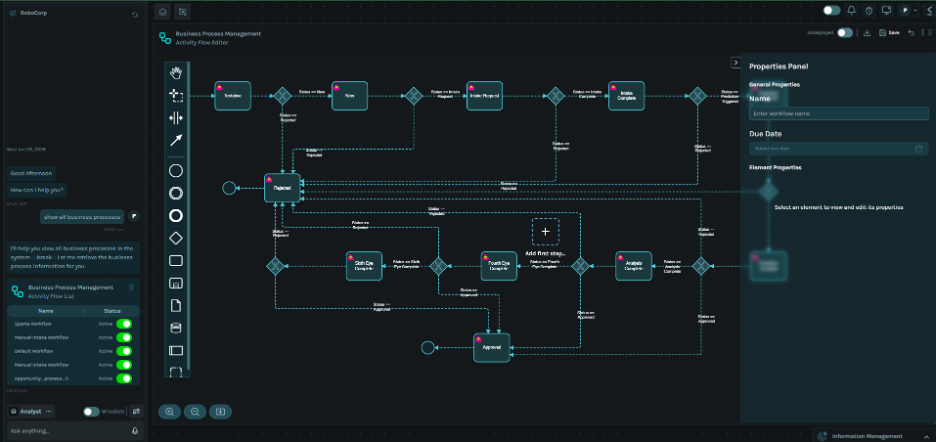
The Graph Workflow system orchestrates multi-step operational processes with human tasks, automated actions, and control mechanisms.
Graph Workflow Architecture
┌─────────────────────────────────────────────────────────────────────┐
│                    GRAPH WORKFLOW ARCHITECTURE                      │
├─────────────────────────────────────────────────────────────────────┤
│                                                                     │
│  ┌────────────────────────────────────────────────────────-─────┐   │
│  │                    PROCESS DEFINITION                        │   │
│  │  ┌─────────────┐  ┌─────────────┐  ┌─────────────┐           │   │
│  │  │  Process    │  │  Task       │  │  Gateway    │           │   │
│  │  │  Designer   │  │  Library    │  │  Config     │           │   │
│  │  └─────────────┘  └─────────────┘  └─────────────┘           │   │
│  └────────────────────────────────────────────────────────────-─┘   │
│                              │                                      │
│  ┌───────────────────────────────────────────────────────────-──┐   │
│  │                    EXECUTION ENGINE                          │   │
│  │  ┌─────────────┐  ┌─────────────┐  ┌─────────────┐           │   │
│  │  │  Process    │  │  Task       │  │  Event      │           │   │
│  │  │  Runtime    │  │  Manager    │  │  Handler    │           │   │
│  │  └─────────────┘  └─────────────┘  └─────────────┘           │   │
│  └──────────────────────────────────────────────────────────-───┘   │
│                              │                                      │
│  ┌───────────────────────────────────────────────────────────-──┐   │
│  │                    INTEGRATION LAYER                         │   │
│  │  • Knowledge Graph   • Rule Engine   • Notification Service  │   │
│  └────────────────────────────────────────────────────────────-─┘   │
└─────────────────────────────────────────────────────────────────────┘
Operational Process Types
| Process Type |
Purpose |
Trigger |
| Entity Onboarding |
Initial entity analysis workflow |
Entity creation |
| Periodic Assessment |
Scheduled re-analysis |
Timer, score change |
| Alert Investigation |
Event-driven analysis |
Detection, manual referral |
| Pattern Analysis |
Deep pattern investigation |
High-risk detection |
| Escalation |
Management review process |
Risk threshold, policy |
Pattern-Based Workflow Triggering
The Rule Engine integrates with Graph Workflows to automatically trigger appropriate workflows based on pattern detection.
Workflow Trigger Flow:
┌─────────────────────────────────────────────────────────────────────┐
│                    PATTERN-BASED WORKFLOW TRIGGERING                │
├─────────────────────────────────────────────────────────────────────┤
│                                                                     │
│  Entity Event ──▶ [Pattern Detection] ──▶ [Rule Evaluation]         │
│       │                  │                      │                   │
│       ▼                  ▼                      ▼                   │
│  (New entity,        (Score calculated)     (Rules matched)         │
│   data change,                                  │                   │
│   alert)                                        ▼                   │
│                                     [Workflow Selection]            │
│                                           │                         │
│              ┌────────────────────────────┼────────────────┐        │
│              ▼                            ▼                ▼        │
│         [Low Risk]                  [Medium Risk]    [High Risk]    │
│              │                            │                │        │
│              ▼                            ▼                ▼        │
│       Standard Review                Extended Review   Critical     │
│        Workflow                       Workflow          Review      │
│              │                            │            Workflow     │
│              └────────────────────────────┼────────────────┘        │
│                                           ▼                         │
│                                    [Task Assignment]                │
│                                           │                         │
│                                           ▼                         │
│                                    [Process Execution]              │
│                                           │                         │
│                                           ▼                         │
│                                     [Audit Trail]                   │
└─────────────────────────────────────────────────────────────────────┘
Workflow Task Types
| Task Type |
Description |
Security Control |
| User Task |
Human action required |
Role-based assignment |
| Service Task |
Automated system action |
Permission validation |
| Script Task |
Custom logic execution |
Sandboxed execution |
| Send Task |
External communication |
Message logging |
| Receive Task |
Wait for external event |
Event validation |
Workflow Security Controls
| Control |
Implementation |
| Process Authorization |
Only authorized users can start processes |
| Task Assignment |
Tasks assigned based on role and workload |
| Escalation Rules |
Automatic escalation on SLA breach |
| Delegation Controls |
Delegation requires approval, logged |
| Completion Verification |
Task completion validated before proceeding |
Workflow Definition Security
| Control |
Description |
| Version Control |
Process definitions versioned |
| Change Approval |
Process changes require multi-party approval |
| Testing Required |
Processes must pass simulation before deployment |
| Rollback Support |
Previous versions can be restored |
| Access Restrictions |
Process definition access role-based |
Task Assignment Security
| Control |
Implementation |
| Role-Based Assignment |
Tasks assigned to roles, not individuals |
| Workload Balancing |
Even distribution across team members |
| Conflict Avoidance |
Prevent assignment to conflicted parties |
| Audit Trail |
All assignments and reassignments logged |
| SLA Monitoring |
Task completion tracked against SLA |
Escalation Controls
| Trigger |
Action |
Security Control |
| SLA Breach |
Escalate to supervisor |
Automatic, logged |
| Risk Threshold |
Escalate to management |
Rule-based, audited |
| Manual Request |
Escalate per request |
Requires justification |
| Timeout |
Reassign or escalate |
Configurable per task |
Process Instance Security
| Control |
Description |
| Instance Isolation |
Each process instance isolated |
| Data Encryption |
Process data encrypted at rest |
| Access Control |
Instance access based on role and assignment |
| State Protection |
State transitions validated and logged |
| Cancellation Control |
Cancellation requires authorization |
External Source Integration
The Graph Operations module integrates with external data sources for entity verification and enrichment.
External Source Categories
| Category |
Examples |
Data Types |
| Corporate Registries |
Corporate filings, registration records |
Incorporation, officers, filings |
| Relationship Data |
Business databases, industry databases |
Connections, associations |
| Public Records |
News, legal records |
Public information, history |
| Regulatory Data |
Regulatory databases |
Compliance records |
| Industry Data |
Industry-specific data |
Sector information |
Source Integration Security
| Control |
Implementation |
| Source Validation |
Only approved sources in registry |
| Credential Isolation |
Per-source credential management |
| Rate Limiting |
Respect source API limits |
| Data Minimization |
Retrieve only required fields |
| Caching Policy |
Time-limited caching per source |
| Provenance Tracking |
Full lineage from source to graph |
Enrichment Workflow
| Stage |
Description |
Security Control |
| Request |
Entity submitted for enrichment |
Authorization check |
| Matching |
Entity matched against external source |
Matching rules applied |
| Retrieval |
Data fetched from external source |
Encrypted transport |
| Fusion |
External data merged with existing |
Conflict resolution rules |
| Validation |
Enriched data validated |
Schema validation |
| Storage |
Enriched entity persisted |
Access control inherited |
| Audit |
Enrichment event logged |
Full audit trail |
Graph Screening Service
The Graph Screening Service performs entity screening against external sources.
Screening Types
| Screening Type |
Sources |
Frequency |
| Database Screening |
Business databases, registries |
Real-time, periodic batch |
| Regulatory Screening |
Regulatory databases |
On-demand, periodic |
| Public Records Screening |
News and public records |
Continuous monitoring |
Screening Security Controls
| Control |
Implementation |
| Match Verification |
Potential matches require human review |
| False Positive Management |
Documented false positive decisions |
| Alert Escalation |
True matches escalated per policy |
| Screening Audit |
All screening activity logged |
| Source Update Tracking |
Source list versions tracked |
Case Management
Operational cases track analyses, investigations, and decision records.
Case Types
| Case Type |
Purpose |
Lifecycle |
| Initial Analysis |
Entity onboarding analysis |
Open → Review → Concluded |
| Deep Investigation |
Detailed pattern investigation |
Triggered → Analyze → Escalate/Close |
| Pattern Review |
Systematic pattern assessment |
Open → Review → Documented |
| Management Review |
Senior review and approval |
Prepared → Review → Approved/Rejected |
Case Security Controls
| Control |
Implementation |
| Access Control |
Case access based on role and assignment |
| Evidence Chain |
All documents and notes timestamped |
| Decision Audit |
All decisions logged with justification |
| Retention Policy |
Cases retained per operational requirement |
| Export Controls |
Case export requires authorization |
User Roles and Permissions
Operations-Specific Roles
| Role |
Description |
Permissions |
| Analyst |
Day-to-day operational analysis work |
Case work, screening review, standard analysis |
| Senior Analyst |
Senior operations staff |
Case approval, pattern override, team management |
| Operations Manager |
Operations leadership |
Escalation approval, full case access |
| Data Coordinator |
Intake and coordination |
Create cases, basic screening, escalate |
| Auditor |
Internal/external auditor |
View all cases, run reports, no edit |
Permission Matrix
| Action |
Analyst |
Senior |
Manager |
Coordinator |
Auditor |
| Create Case |
✓ |
✓ |
✓ |
✓ |
✗ |
| Review Case |
✓ |
✓ |
✓ |
✗ |
✓ |
| Approve Case |
✗ |
✓ |
✓ |
✗ |
✗ |
| Override Assessment |
✗ |
✓ |
✓ |
✗ |
✗ |
| Escalate Case |
✗ |
✓ |
✓ |
✗ |
✗ |
| Modify Rules |
✗ |
✓ |
✓ |
✗ |
✗ |
| View Reports |
✓ |
✓ |
✓ |
✗ |
✓ |
Audit Logging
Operations-Specific Events
| Event Category |
Logged Data |
Retention |
| Case Created |
Case ID, entity, creator, type |
3 years |
| Case Decision |
Case ID, decision, approver, justification |
3 years |
| Pattern Detection |
Entity, score, factors, detector |
3 years |
| Screening Performed |
Entity, sources, matches, reviewer |
3 years |
| Rule Executed |
Rule ID, inputs, score, actions |
1 year |
| Process Executed |
Process ID, tasks, outcomes |
1 year |
| Escalation |
Case ID, escalation reason, recipient |
3 years |
Operational Retention
| Category |
Retention Period |
Data Types |
| Active Case Data |
Duration + 1 year |
Analysis records, decisions |
| Closed Cases |
3 years minimum |
Complete case files |
| Audit Records |
3 years |
All system activity |
| Rule Changes |
Indefinite |
Rule versions and history |
Reporting and Analytics
Operations Dashboards
| Dashboard |
Purpose |
Access |
| Case Queue |
Active cases and assignments |
All operations roles |
| Pattern Overview |
Entity pattern distribution |
Manager |
| SLA Monitoring |
Task completion against targets |
Manager |
| Screening Alerts |
Pending screening matches |
Analyst, Manager |
| Operations Dashboard |
Management information metrics |
Manager |
Report Security
| Control |
Implementation |
| Role-Based Access |
Reports filtered by user permissions |
| Data Aggregation |
Individual data protected in summaries |
| Export Logging |
All report exports logged |
| Scheduled Reports |
Automated reports require authorization |